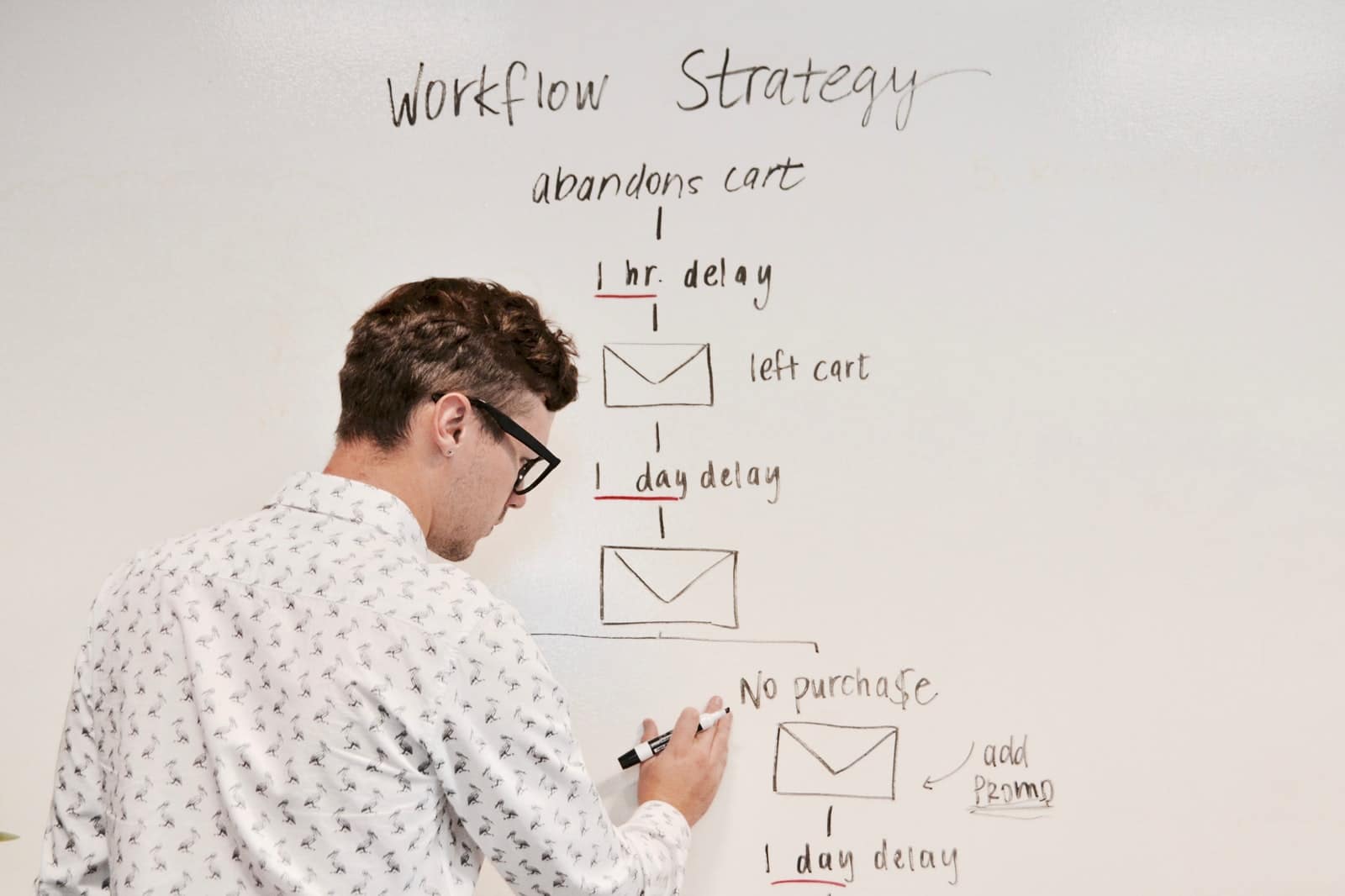
Business process improvement is one of the most important elements of a successful digital transformation. Without it, technology investments rarely deliver the business value organizations expect. But the term itself can feel abstract, especially for teams encountering it for the first time. If you are preparing for a transformation, there are several foundational concepts you need to understand before you start redesigning how your organization operates. Here are the ten most important ones.
1. As-Is (Current State) Business Processes
As-is mapping refers to documenting how your business processes work today: who does what, how information flows across the organization, and what steps are taken within each segment of your operations. Understanding your current state is essential because you cannot improve what you have not clearly defined.
That said, as-is mapping does not need to be exhaustive. In our experience, organizations that spend too much time documenting every detail of their current state often get stuck in analysis paralysis and never reach the actual improvements. The key is to find the right balance between understanding where you are today and moving forward toward the future state.
2. To-Be (Future State) Business Processes
To-be mapping is where you take the current state, build on it, and revise it to align with your strategic vision. If your goal is to be the fastest fulfillment operation in your industry, for example, then your future-state process work needs to focus specifically on the ordering and fulfillment processes that affect delivery lead times.
This work involves analyzing where breakdowns and inefficiencies exist, identifying manual processes and data silos, and addressing organizational handoff issues. The result is a blueprint for how you want the organization to operate in the future, including the process changes, technology investments, and organizational improvements required to get there.
3. End-to-End Processes
When mapping current and future state processes, it is important to look at them from start to finish rather than in departmental silos. This means not just analyzing accounts payable, inventory management, or customer service in isolation, but examining the full process flow across all touchpoints and handoffs.
End-to-end process mapping reveals where breakdowns happen between departments, which is often where the most critical issues live. When we advise clients on business process optimization, we always start with the end-to-end view before drilling into individual functions. This ensures that improvements in one area do not create new problems downstream.
4. Process Reengineering
While process improvement focuses on refining existing workflows, process reengineering takes a more fundamental approach. It involves rethinking how a process works from the ground up: how to improve efficiency and effectiveness, remove bottlenecks, automate through technology, or restructure the organization to better support the workflow.
There are several sources of insight for reengineering. Start by identifying what is not working today and where the most significant breakdowns exist. Then evaluate what technologies could help streamline and automate those processes. You can also benchmark against peers in your industry or adjacent industries to understand what others are doing to improve their operations.
5. Bottlenecks
A bottleneck is a point in a process where the workflow slows down or gets stuck. It can occur because of insufficient capacity, a lack of automation, or confusion during a specific step.
A common example is a manufacturing shop floor where a single machine handles a critical step for every production order. Multiple upstream processes feed into that one machine, and if it cannot keep up, the entire production line slows down. The same concept applies to people. If employees do not have the right tools or there are not enough people to handle the volume, bottlenecks emerge. Identifying and mitigating bottlenecks is one of the most immediate ways to improve process performance.
6. Performance Measures and KPIs
Every process should have metrics that quantify how it is performing in terms of efficiency, effectiveness, quality, or cost. These key performance indicators (KPIs) give you a baseline for measuring improvement and a target for where you want to be in the future.
As part of any business process improvement initiative, it is important to define what you are measuring today and what you want those metrics to look like after the transformation. Without clear KPIs, it is difficult to demonstrate that your process work actually delivered value. In our experience, organizations that establish baselines early and track them through go-live and beyond are far more successful at proving ROI on their transformation investments.
7. Six Sigma
Six Sigma is a quantitative, quality-focused methodology for improving business process outcomes. It became widely adopted in the 1980s and 1990s through companies like Motorola and General Electric, and it continues to be a rigorous, statistically grounded approach used in process improvement.
Six Sigma focuses on reducing variation and defects in processes through a structured problem-solving framework (DMAIC: Define, Measure, Analyze, Improve, Control). It is particularly effective in manufacturing and operations-heavy environments, but the principles apply broadly to any process where consistency and quality matter.
8. Business Process Mining Software
Process mining is a relatively new category of technology that can significantly accelerate your understanding of how processes actually work in practice. These tools connect to your existing systems and analyze transactional data to map out the real process flows, including how long each step takes, where variations occur, and where bottlenecks exist.
Process mining is valuable because it augments qualitative insights from interviews and workshops with quantitative data from your actual operations. It can reveal patterns and inefficiencies that would be difficult to identify through manual analysis alone, making it a powerful complement to traditional data and AI integration efforts within a transformation.
9. Gap Analysis
Gap analysis has two distinct applications in business process improvement. The first compares your current state processes to your future state processes to catalog and prioritize every change that needs to happen. This is critical for planning, communication, and sequencing.
The second type of gap analysis is technology-focused. It compares your future state process requirements against the capabilities of potential software platforms to identify where the software fits well out of the box and where customization or workarounds may be needed. Both types of gap analysis are essential inputs into your ERP selection and implementation decisions.
10. Change Impact
Change impact analysis examines the specific differences between your current state and future state to understand who is affected by each change, how their roles and responsibilities will shift, and what parts of their daily work will be automated or restructured.
This analysis is the foundation of a strong organizational change management strategy. Without it, change management becomes generic and reactive rather than targeted and proactive. In our experience, the organizations that invest in detailed change impact analysis before go-live consistently see higher adoption rates and less resistance from employees.
How Do You Prioritize Which Processes to Improve First?
Not all processes deserve the same level of attention. When we advise clients on prioritization, we recommend separating processes into two categories: core competencies (the differentiators that give you a competitive advantage) and commodity processes (essential functions like accounts payable or payroll that every organization performs).
Core competencies should receive the most investment in process improvement and reengineering because they directly affect how you win in the market. Commodity processes, on the other hand, often benefit most from adopting standard software functionality rather than custom process design. This prioritization ensures that limited time and resources are focused where they will deliver the greatest business value.
What Is the Relationship Between Business Process Improvement and Digital Transformation?
Business process improvement is not a separate initiative from digital transformation. It is a core component of it. The technology decisions you make should be driven by the process improvements you want to achieve, not the other way around.
Organizations that skip process work and jump straight into software implementation often end up automating broken processes, which delivers little value and can actually make things worse. The most successful transformations we see are those where process improvement, technology selection, and digital transformation strategy are planned and executed as an integrated effort from the beginning.
When Should You Bring in Outside Help for Process Improvement?
Many organizations have the internal knowledge to identify what is not working in their processes. Where they often need support is in facilitating cross-functional process workshops, benchmarking against industry standards, managing the intersection of process design and technology selection, and ensuring that process improvements are sustainable after go-live.
If your organization is preparing for a transformation and wants guidance on how to approach your supply chain, operations, and process improvement work, contact us at eric.kimberling@thirdstage-consulting.com.y. I’m always happy to be an informal sounding board when it comes to your corporate and digital strategy.

Eric is recognized globally as a leading voice in digital transformation and ERP strategy. Over the past two decades, he has helped hundreds of organizations – including Nucor Steel, Fisher & Paykel Healthcare, Kodak, Coors, Boeing, and Duke Energy – define their technology roadmaps, modernize complex operations, and deliver real business value from large-scale transformation initiatives.
As Founder and CEO of Third Stage Consulting, Eric leads an independent, technology-agnostic advisory firm focused on helping clients navigate the shift from traditional ERP to more flexible, AI-enabled Digital Enterprise Operations (DEO) models. His work spans ERP selection, implementation quality assurance, organizational change, and operating model design across a wide range of industries and geographies.
Eric is also a prolific thought leader, known for his pragmatic takes on AI, cloud, and enterprise software trends, as well as his firm’s benchmark research and frameworks for de-risking transformation. He is dedicated to helping executive teams cut through vendor hype, make confident investment decisions, and successfully reach the “third stage” of their digital evolution.